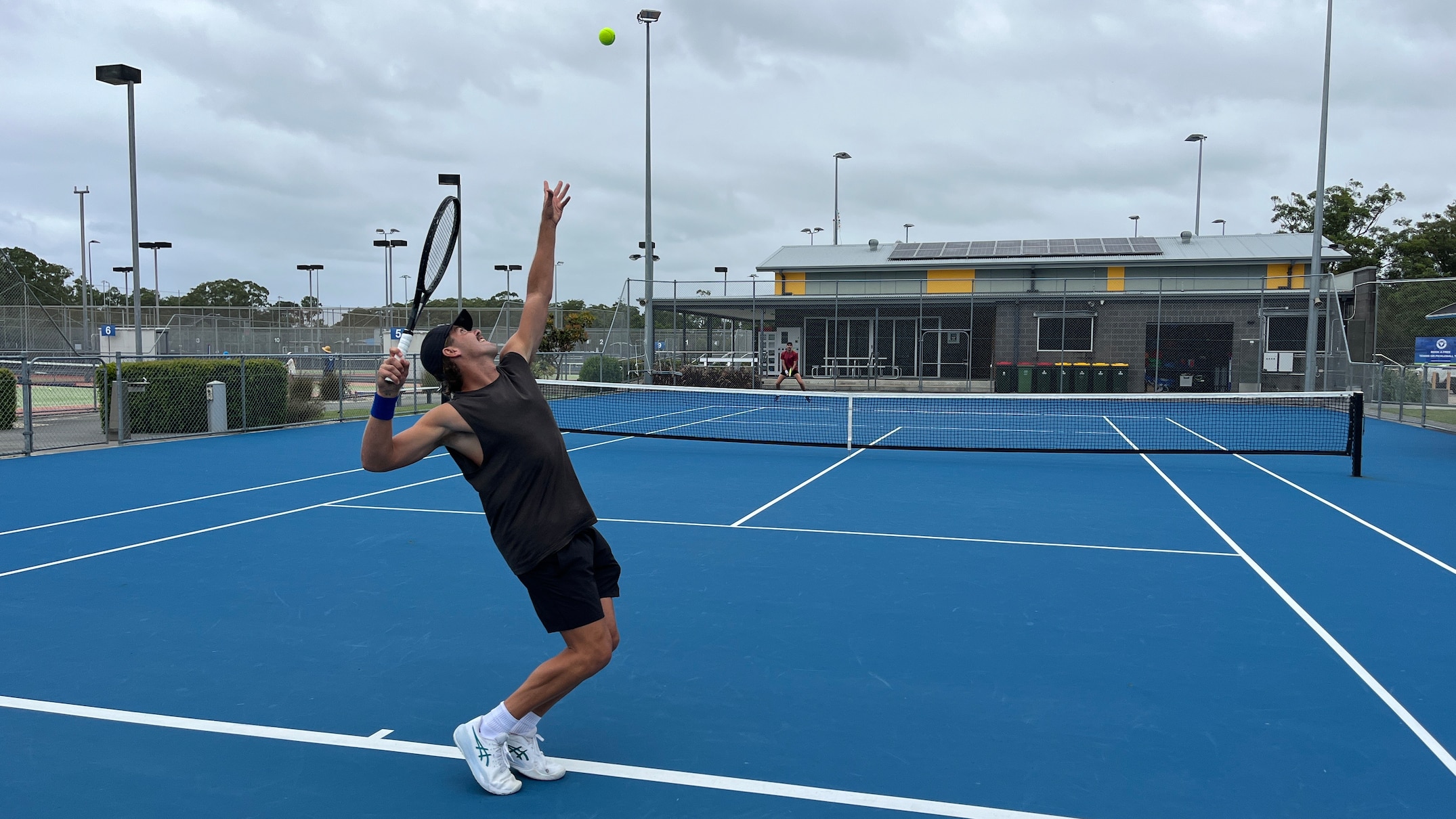
Australian doubles player Thomas Fancutt believed tennis had turned its back on him at the very moment his career was beginning to flourish.
Two hours following his debut at the 2025 Australian Open, Fancutt was approached by the International Tennis Integrity Agency (ITIA).
He was extensively questioned regarding alleged doping, and before long, his career came to a standstill.
"I wasn't really able to celebrate the fact that I was participating in a slam," he said.
I was somewhat taken aback when the ITIA representatives told me there was an ongoing investigation.
A 30-year-old athlete received a doping violation and was suspended for two years after surpassing the allowed intravenous (IV) infusion levels.
The watchdog became involved following Fancutt sharing a video of himself receiving a 500 millilitre IV drip with Vitamin B, Vitamin C, and magnesium.
Fancutt mentioned he received the injection to combat fatigue.
"I participated in roughly 12 tournaments over 13 weeks, mainly to attempt to qualify for the Australian Open, and I was experiencing severe burnout and tiredness," he stated.
The World Anti Doping Agency (WADA) and the Tennis Anti-Doping Programme (TADP) regulations specify that athletes are allowed a maximum of 100 millilitres of fluid administered via injection within a 12-hour timeframe..
Fancutt challenged the two-year suspension, which was cut down to 10 months once the ITIA acknowledged his reasoning.
"The ITIA acknowledges that, given all the circumstances, the Player's breach was not 'intentional,' " the organization stated in August of last year.
IV drips are restricted to prevent athletes from using them to boost their performance or conceal other banned substances.
Sportspeople must adhere to the regulations regarding performance-enhancing substances.
The door shuts
At that time, Fancutt held the 107th position globally in doubles, yet the suspension prevented him from training at any venues covered by Tennis Australia's insurance, and he was also prohibited from watching his friends compete in events.
"I was truly exiled... it's been my life, I grew up at a tennis centre... it felt like I couldn't return home," he said.
I definitely went through some tough times where I considered giving up, feeling like the world was working against me and I was being unfairly punished for a simple error.
Although some players expressed empathy, sending messages to indicate they were unaware of the restrictions on vitamin infusions, many rushed to criticize.
"I received messages from people stating that I am a disgrace to my family and my country, even though the facts were not yet public and I was being criticized," he said.
We're simply individuals who occasionally make genuine errors, I was truly unaware of the IV rule and didn't gain any advantage from it.
Elite athletes may undergo unannounced testing because certain substances are only detectable for a brief period.
For a test to be effective, Sports Integrity Australia must collect samples within a brief period after an athlete might have consumed or received a prohibited substance.
It's not only the substances athletes consume that can lead to violations of WADA rules, but also the techniques they use.
The head of anti-doping operations at Sport Integrity Australia, Chris Butler, stated that infusions exceeding 100 millilitres are banned as they might conceal the use of performance-enhancing substances.
"It is crucial to grasp the distinction between a banned substance and a banned technique, and an infusion may fall into both categories," he stated.
IV infusions could potentially affect the readings we observe via the blood, the biological passport of the athlete.
That's why the quantity is important since WADA has concluded that [100 millilitres] is not sufficient to either improve your performance or conceal a substance or interfere with the blood profile.
Player's responsibility
An ITIA representative informed ABC that the onus was on the athlete.
"The responsibility lies with them to make sure anything they consume is safe, doesn't include a banned substance, or isn't used in a restricted way," he stated.
Mr Butler agreed.
"Has the athlete been negligent or not, and to what extent?" he stated.
The ITIA conducted tests on over 9,000 athletes during 2024.
Among them, only six athletes received penalties from the Tennis Anti-Doping Program, including top male and female players Jannik Sinner and Iga Świątek.
Sinner received a three-month banfollowing two positive tests for an anabolic substance known as Clostebol.
The prohibited substance was discovered in a non-prescription spray, which he claimed a team member used to address a minor injury.
Świątek received a one-month banFollowing a positive test for a prohibited substance known as Trimetazidine, which she used to manage jet lag.
The comeback
Fancutt is still repaying his $25,000 penalty and working his way back up the rankings.
He is also chronicling his experiences on social media, offering young supporters a glimpse into the efforts required to achieve success.
Last month, Fancutt participated as a wildcard in the semi-professional Tweed Open, emerging victorious without losing a single game.
He subsequently collected the silverware at Brisbane's Churchie Open.
"Frankly, I'm really excited to be back, it felt like I was a child again on the court, I just missed the competition," he said.
Having been through both situations, somewhat like a forced retirement and then being on the tour, the global tour is definitely better, I wouldn't exchange it for anything.
Comments
Post a Comment